
Master and protégé: what is Paul Kagame to Joseph Kabila?
From Kigali in 1995 to Goma in 2025, a trail of episodes, statements and military deals keeps raising the same question about Joseph Kabila and Paul Kagame. From the historical archives to the Rwandan president's own words, we retrace a political and security relationship whose true nature has yet to be fully laid bare.
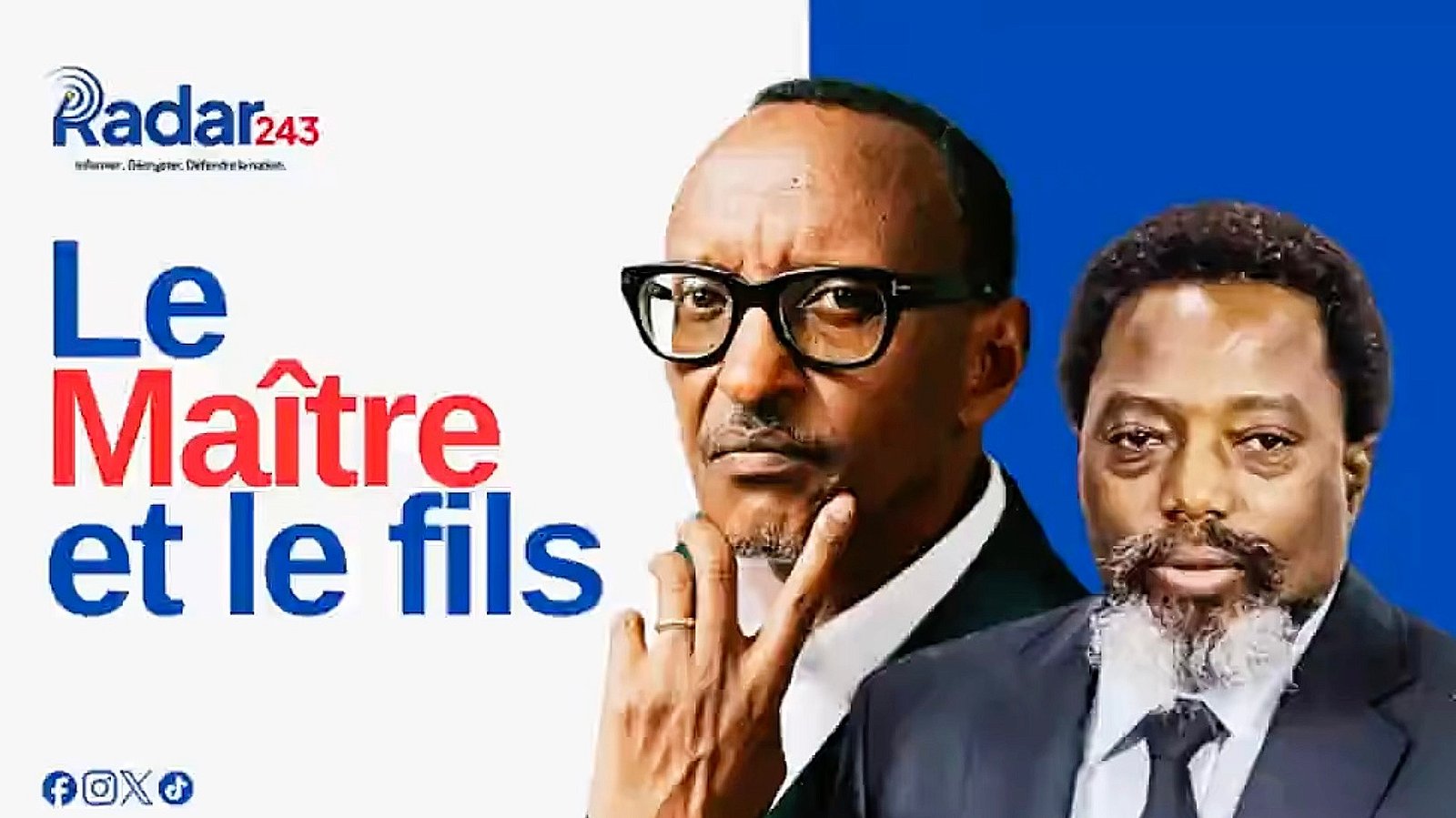

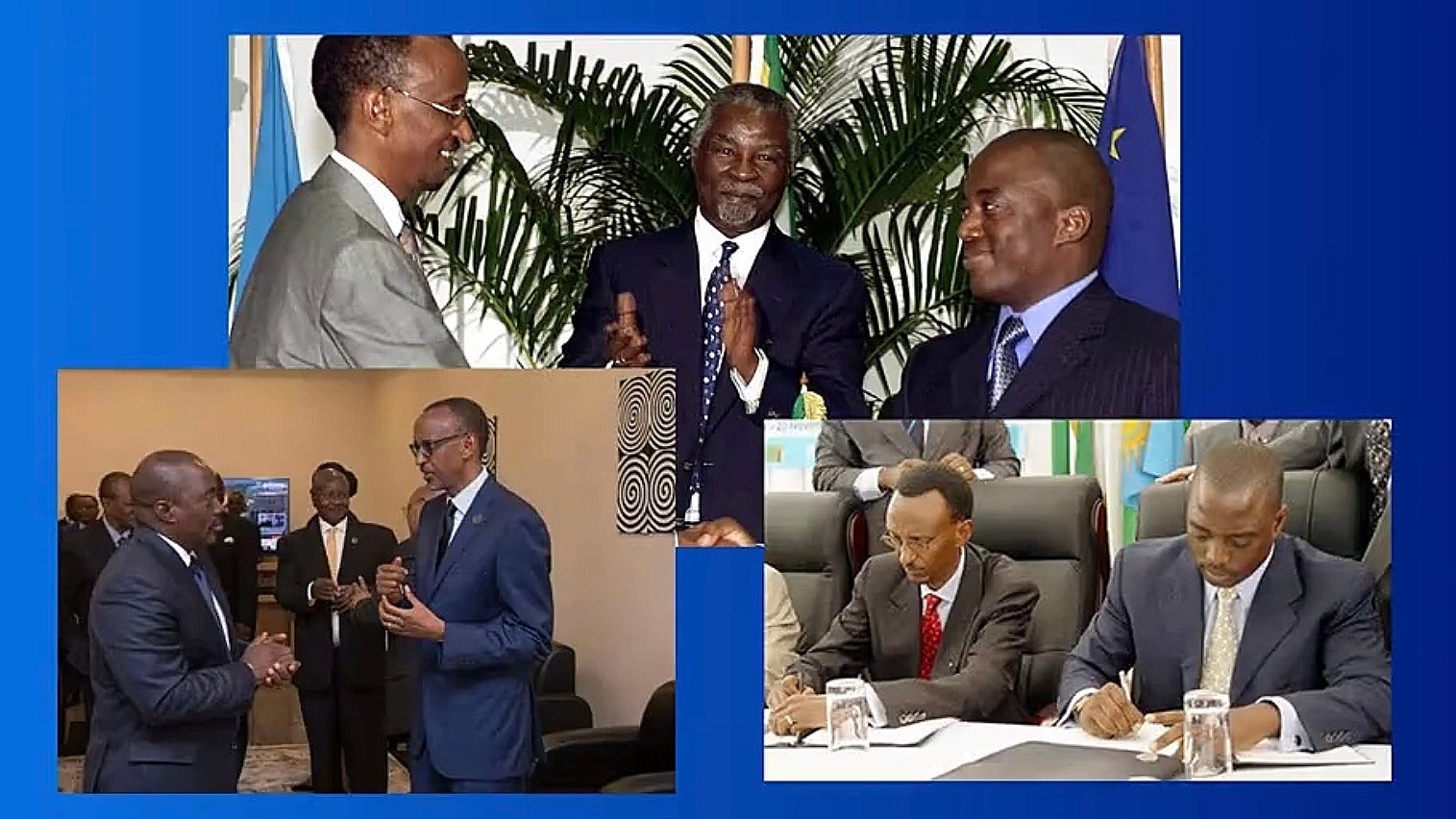
From Kigali to Goma, a thirty-year timeline reveals a pattern of rapprochements, statements and military episodes that raise hard questions about the relationship between former Congolese president Joseph Kabila and Rwandan president Paul Kagame.
1995: Joseph Kabila, already in Rwanda's orbit
The story begins long before Joseph Kabila became president of the Democratic Republic of the Congo.
He was already moving in a regional landscape shaped by political and military alliances.
A publication by Belgium's AfricaMuseum on South Kivu, drawing on historical research, reports that Laurent-Désiré Kabila, his son Joseph and Justin M'Molelwa arrived in Kigali on November 11, 1995.
Joseph Kabila's reported presence in Kigali is the first marker on this timeline. On its own, it does not prove Kagame hand-picked him to run Congo. But it does raise a historical question: what ties did Joseph Kabila forge with Rwandan officials during this period?
1996: James Kabarebe, a relationship that needs explaining
The first Congo war broke out in 1996. The Alliance of Democratic Forces for the Liberation of Congo (AFDL), led by Laurent-Désiré Kabila, marched on Kinshasa with the backing of regional forces, at a time when Rwanda was playing a major military role.
This is where James Kabarebe comes in: a Rwandan officer who would go on to become a towering figure in Rwanda's military establishment.
A statement attributed to Joseph Kabila describes Kabarebe as his mentor in 1996. If the quote holds up in its original context, it is another piece of the puzzle in understanding the personal and military bonds that may have formed around the AFDL campaign.
Still, Kabarebe's documented role in regional operations must be kept separate from how one reads the relationship. Being called a mentor is not proof that Joseph Kabila was installed at the head of Congo on Kigali's orders.
The question remains wide open:
What part did Rwandan officials play in Joseph Kabila's political and military rise?
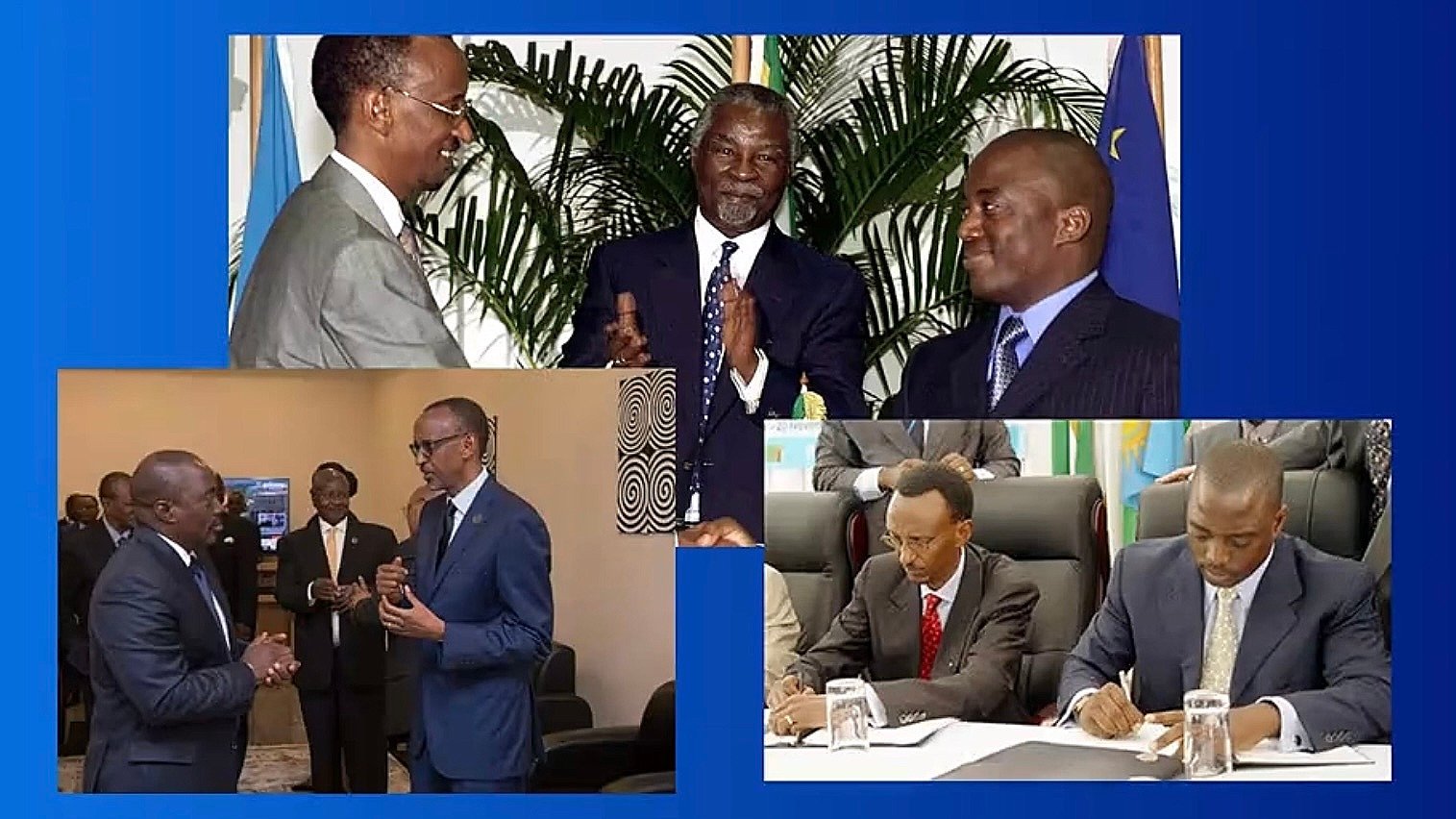
February 2001: days into the job, Joseph Kabila sits down with Paul Kagame
On January 26, 2001, Joseph Kabila was sworn in, formally succeeding his father, Laurent-Désiré Kabila, at the head of the Democratic Republic of the Congo.
Barely a week later, on February 1, he met Paul Kagame in Washington, on the sidelines of the National Prayer Breakfast hosted by US president George W. Bush.
The meeting came while the DRC and Rwanda were still locked in a regional war. The two men spoke for about half an hour. Just days into the job, Joseph Kabila was already in direct talks with Paul Kagame, the president of a country embroiled in Congo's war.
This first known official meeting between the two men kicked off a series of diplomatic contacts that would continue for years.
So the relationship between Kabila and Kagame is not just one between two heads of state. It is woven into a history of war, negotiation and security cooperation that has left deep scars on the people of eastern DRC.
2008: Kagame says Kabila came to him for help
In December 2008, in an interview with the Financial Times, Paul Kagame looked back on his dealings with Joseph Kabila around Congo's elections.
Kagame said Kabila had asked him for help both before and after the vote. He explained that the two men talked about Congo's problems and that the Congolese president had asked him, in particular, to lean on political figures tied to the former RCD rebel movement.
These remarks matter because they come from Paul Kagame himself. They describe a level of contact and political cooperation that goes well beyond ordinary diplomacy.
But they also beg a question:
Why was Congo's president asking his Rwandan counterpart to intervene in Congolese domestic politics?
Kagame frames this help as an effort to promote regional stability. Others may read it as a sign of how much sway Kigali held over Congo's political balance. The statement alone cannot settle the matter.
2009: Kinshasa and Kigali go to war together
In January 2009, the Congolese and Rwandan governments launched a joint military operation, Umoja Wetu, officially targeting the Democratic Forces for the Liberation of Rwanda (FDLR) in eastern DRC.
The operation followed a stretch of tension and fighting in North Kivu.
It was a stunning about-face: Rwandan troops were back on Congolese soil, this time in a joint operation with the Congolese army. At the same time, the CNDP, an armed movement that had been fighting government forces, was folded into Congo's military.
That integration was far from complete. Reports document how old command structures survived and how hard it was to absorb CNDP fighters into the FARDC. Human Rights Watch also described the fallout of this reshuffle for civilian safety.
The 2009 operation was a turning point in relations between the two countries. Former battlefield enemies were now official partners, while armed groups spawned by earlier wars kept a firm grip on eastern Congo.
This chapter is key to what came next: a few years later, a new rebellion, the M23, would emerge, largely out of tensions over the integration of former CNDP fighters.
June 30, 2010: Congo marks fifty years of independence, and the world comes to Kinshasa
On June 30, 2010, the Democratic Republic of the Congo celebrated fifty years of independence. Heads of state and foreign delegations flocked to Kinshasa, among them Rwandan president Paul Kagame.
It was meant to be a celebration of the country's history, its sovereignty and half a century of independence.
But one detail of that day would stick in people's minds.
The military parade started more than two hours late, because the assembled delegations were waiting for Paul Kagame.
A journalist on the scene explained that every guest, including Congo's own president, was waiting for the Rwandan leader, whose plane had just touched down in Kinshasa.
It is a striking image.
A nation celebrates fifty years of independence.
The world gathers in its capital.
And the parade waits for the president next door.
The episode is, at the very least, a starting point for examining the relationship between the two leaders. After years of war, tension and military cooperation, how much weight did Rwanda carry in Congo's political balance?
And what are we to make of the importance attached to Paul Kagame's presence at such a symbolic national moment?
2012: Kagame claims Rwanda's ties reach the very top in Kinshasa
In 2012, as the M23 took up arms in eastern DRC, relations between Kinshasa and Kigali were once again under the international spotlight.
In an interview with Al Jazeera, Paul Kagame was asked about accusations that Rwanda was backing the rebellion. Kagame replied:
"Let me correct you. It is not only those fighting in the CNDP or in the so-called rebellion called M23 who have been associated with Rwanda or the Rwandan army. Even those who are in the government today have been part of that."
He went on:
"There is no one in the Congolese government, starting exactly with its head, who has not been in association with us."
That statement deserves close attention. By saying the ties with Rwanda started "exactly with its head", Kagame was pointing to the very top of Congo's government at the time, led by Joseph Kabila.
These words do not, on their own, prove that Kabila took orders from Kagame. But they are a public claim by the Rwandan president that Kigali had ties to Congolese officials all the way up to the highest office in the land.
The context makes the claim even weightier. In 2012, the M23 was in open rebellion against the Congolese government. UN reports accused Rwanda of backing the movement, while Kigali flatly denied it.
So the question is not just whether the two leaders had a relationship. It is what that relationship was, how far it went, and what it cost the DRC in sovereignty and security.
2025: Joseph Kabila, out of office since 2018, resurfaces in M23-held Goma
On May 25, 2025, Joseph Kabila arrived in Goma, a city in the hands of the AFC/M23 since the January offensive.
Elected in 2006, re-elected in 2011 and succeeded after the 2018 presidential election, the former president of the Democratic Republic of the Congo returned to a country plunged into a fresh political and military crisis.
His return came after several years abroad. The former president said he wanted to play a role in resolving the national crisis. His appearance in Goma caused a stir, not least because the city was under AFC/M23 control.
The movement's spokespeople confirmed his arrival and welcomed him to what they call the "liberated zones". That public messaging gave his trip unmistakable political weight.
Kabila's presence in an M23-held city came as Congolese authorities accused him of links to the rebellion. He disputes these accusations, and they must be kept separate from the established facts about his trip and the public statements surrounding it.
But set against a timeline that begins in 1995, his return to Goma inevitably raises questions. What should we read into a former president turning up in a city held by an armed movement born out of eastern Congo's military reshuffles?
And how does this chapter fit into the longer story of his ties to Paul Kagame and to the region's political and military players?
The archives, the statements, and the question that won't go away
The episodes on this timeline are not all of a kind. Some are documented in historical or institutional reports. Others rest on public statements, archive footage or accounts whose limits must be acknowledged.
But taken together, they bring several points into focus:
- A historical publication places Joseph Kabila in Kigali in November 1995.
- The AFDL's campaign and the first Congo war unfolded amid a regional intervention in which Rwanda played a leading role.
- Paul Kagame says publicly that Joseph Kabila asked him for help and that they discussed Congo's political problems.
- In 2009, Kinshasa and Kigali ran a joint military operation on Congolese soil.
- In 2012, Kagame claimed Rwanda's ties extended to officials at the very top of Congo's government.
- In 2025, Joseph Kabila resurfaced in Goma while the city was under AFC/M23 control.
None of this proves that Joseph Kabila was Paul Kagame's political "son", or that the Rwandan president ran Congo through him. But it does give us concrete reference points for examining the political, military and personal ties between the two men.
Kagame's own words, the records of joint military operations and the events in Goma let us move past rumour and ask precise questions.
What was the relationship between Joseph Kabila and Paul Kagame, really?
Two leaders cooperating on shared regional challenges? A relationship of political and military influence? Or something closer, of which the public record shows only the tip?
The footage is there. The statements are there. The archives are there.
Now it is up to each of us to look at them, weigh them, and draw our own conclusions from the facts.
Radar 243 — Inform. Decode. Defend the nation.
Sources
-
AfricaMuseum — Historical publication on South Kivu: View the document
For the passage reporting the arrival of Laurent-Désiré Kabila, Joseph Kabila and Justin M'Molelwa in Kigali in November 1995.
-
Financial Times — Interview with Paul Kagame, December 12, 2008: Read the interview as reproduced on Paul Kagame's website
For Kagame's account of Joseph Kabila's requests for help and their political exchanges.
-
Human Rights Watch — Report on the joint operations and CNDP integration, December 2009: View the report
For Operation Umoja Wetu, the deployment of Rwandan forces and the CNDP's integration into the Congolese army.
-
US State Department — Human rights report on the DRC, 2009: View the report
For the conduct of the joint operation and its documented impact on civilians.
-
Al Jazeera — Interview with Paul Kagame, July 2012: Watch the interview
For the context of the interview on Rwanda-DRC relations and the allegations of support for the M23. The exact wording of the quote used here should be checked against the original footage.
-
Al Jazeera — Allegations of Rwandan support for the M23, July 9, 2012: Read the article
For the international allegations and Kagame's denial.
-
Actualité.cd — Joseph Kabila announced in Goma by the AFC/M23, May 26, 2025: Read the article
For the movement's public statements and details of his arrival.