

Words are weapons: Radar 243's 12-point guide to calling Rwanda's war what it is
In this war, words are weapons too. Some phrases, repeated without a second thought on the radio, in the papers or on WhatsApp, normalise the aggression, blur who is responsible and do the aggressor's PR for free. Radar 243 has chosen its words. Here they are, one by one, each backed by the facts. Read them, use them, share them.

Say this / Not that
- Say "M23/RDF", not just "AFC", and not whatever new name they come up with.
- Say "Rwandan aggression", not "rebellion".
- Say "occupied territories", not "liberated zones".
- Say "the government" or "the institutions", not "the Kinshasa regime".
- Say "an attack on the whole DRC", not "the crisis in the east".
Why words matter
Modern wars are also won in people's heads. Every time a news outlet writes that "the rebels liberated Goma", every time someone shares a post about "the Kinshasa regime rejecting peace", the aggressor scores a point without firing a shot. It plants the idea of a fight among Congolese, of a government without legitimacy, of a population relieved to be "freed". None of that is true. And that is precisely why those words are being pushed.
Choosing your words is not a detail. It is an act of national defence.
1. New name, same M23/RDF
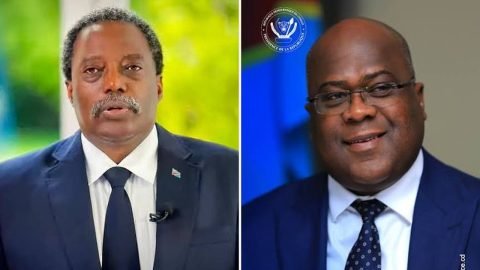
On October 12, 2026, the AFC/M23 rebranded once again, with a new name and Joseph Kabila at the top. Same commanders, same weapons, same sponsor. It's nothing new: CNDP, M23, AFC and now another acronym. Every time, the goal is the same: to make people forget the crimes committed under the old name.
A new acronym must not wipe the slate clean. Radar 243 says M23/RDF, because the UN has documented that the AFC/M23 and the Rwandan army took Goma and Bukavu "jointly".
2. It's not a rebellion. It's an invasion.
Yes, some Congolese have joined the M23/RDF. But behind them stands a foreign army: an estimated 6,000 to 7,000 Rwandan troops in the Kivus at the end of 2025, according to UN experts, and Kigali's own official admission of "security coordination" in January 2026. Rebellions rise up from a people. This one was manufactured by a foreign army. Calling this war an internal conflict means parroting Kigali's script word for word.
3. The foot soldiers and the man giving the orders
Joseph Kabila, Corneille Nangaa, Bertrand Bisimwa, Sultani Makenga: they are the faces. The decisions are taken in Kigali. Washington isn't fooled: its sanctions hit not just the M23 leadership and Joseph Kabila, but the Rwandan army, Rwanda's defence ministry and the army's financial networks. When we talk about this war, let's name the man calling the shots, not just the ones carrying them out.
4. The FDLR don't justify an invasion
Around 1,000 fighters in early 2025, according to the UN. No major attack on Rwandan soil since 2019. And the FDLR's first victims have always been Congolese civilians. Their presence gives no one the right to occupy our cities and our mines. Every time someone answers a question about the occupation with "but what about the FDLR…", they're changing the subject. Don't let them.
5. It's also a war over our resources
The figures are public. According to UN experts, the M23 smuggled at least 150 tonnes of coltan into Rwanda in 2024, the biggest contamination of the region's supply chain ever recorded. It was raking in at least 800,000 dollars a month in taxes on coltan from Rubaya, which produces around 15 percent of the world's supply. On June 25, 2026, Washington sanctioned a Rwanda-based gold refinery for processing gold mined in the occupied zones.
The coltan in our phones, the gold in our jewellery, the tin in our laptops: that's what is bankrolling this war. Congo's minerals should benefit the Congolese, not pay for their suffering.
6. It's not "Kinshasa's war"
Imposed by whom, and on whom? On June 13, 2022, the M23 seized Bunagana, on the Ugandan border. In January 2025, Goma. In February, Bukavu. In December, Uvira, six days after the Washington accords were signed. Every offensive came from the same direction. Congo's army isn't fighting a war of choice: it is defending national territory, as any army in the world would.
7. There is no "Kinshasa regime"
Talking about the "Kinshasa regime" implies there's another legitimate authority in Goma or Bukavu. There isn't. There is one Republic, with elected institutions and a central government. You can criticise that government: that's every citizen's right. But don't use language that reduces it to just one faction among many. The fact that some Congolese politicians use it tells you which side they're on.
8. They took up arms against their country, not against one man
Congolese who joined the M23/RDF say they are fighting Félix Tshisekedi. In reality, they have taken up arms against their own country, alongside a foreign army. They are not opposition figures. They are accomplices to aggression. Presidents come and go; the Republic endures. You take on a president at the ballot box, not with your neighbour's army.
9. Occupied, not liberated
Goma, Bukavu, Bunagana and Rubaya have not been "liberated". They are occupied. Liberation means giving people back their freedom. In these cities, UN experts document executions, disappearances, forced recruitment and illegal taxation. Occupied Congolese territory is still Congolese territory, and it will return to the authority of the Republic.
10. It's not "the crisis in the east"
The whole DRC is under attack. What happens in Goma matters in Kinshasa, Lubumbashi, Kisangani and Mbandaka. Displaced families are arriving in every province, prices are rising everywhere and the national budget is being poured into defence. The east isn't some other Congo. The east is Congo.
11. The M23/RDF doesn't speak for the people of the east
Who gave it a mandate? No one. No election, no vote, no consultation. The people of North and South Kivu are Congolese like everyone else. They never chose the men claiming to speak for them, often at gunpoint. A movement that has to terrorise people to govern them doesn't represent them.
12. The DRC isn't rejecting peace. It's demanding a just peace.
The DRC signed in Washington in December 2025 and is pursuing the Doha process. It wants peace more than anyone, because it's Congo's children who are dying. But not a peace that rewards the aggressor, legitimises the occupation or launders the plunder. A peace that respects our borders and our sovereignty. Rejecting an unjust peace is not rejecting peace.
The bottom line
Every word counts. Let's stop doing the aggressor's PR for free. Before you share a post, a video or a headline, ask yourself: what words does it use, and who do they serve? Radar 243 has made its choice: call things by their name. M23/RDF. Rwandan aggression. Occupied territories. One Republic. Share this guide.
Sources. Experts' report S/2025/446; Reuters, 150 tonnes of coltan; Swissinfo, "unprecedented" smuggling; Reuters / The EastAfrican, Rubaya and 15% of global coltan; RFI via Dakaractu, Oct. 12, 2026.